autocad 3d drawing line perpendicular to plane
In SketchUp, section planes cut a model forth a plane so that yous can peer inside the model - without moving or hiding any geometry. In a 3D model, an active section plane hides everything on one side of the plane, as shown in the following figure.
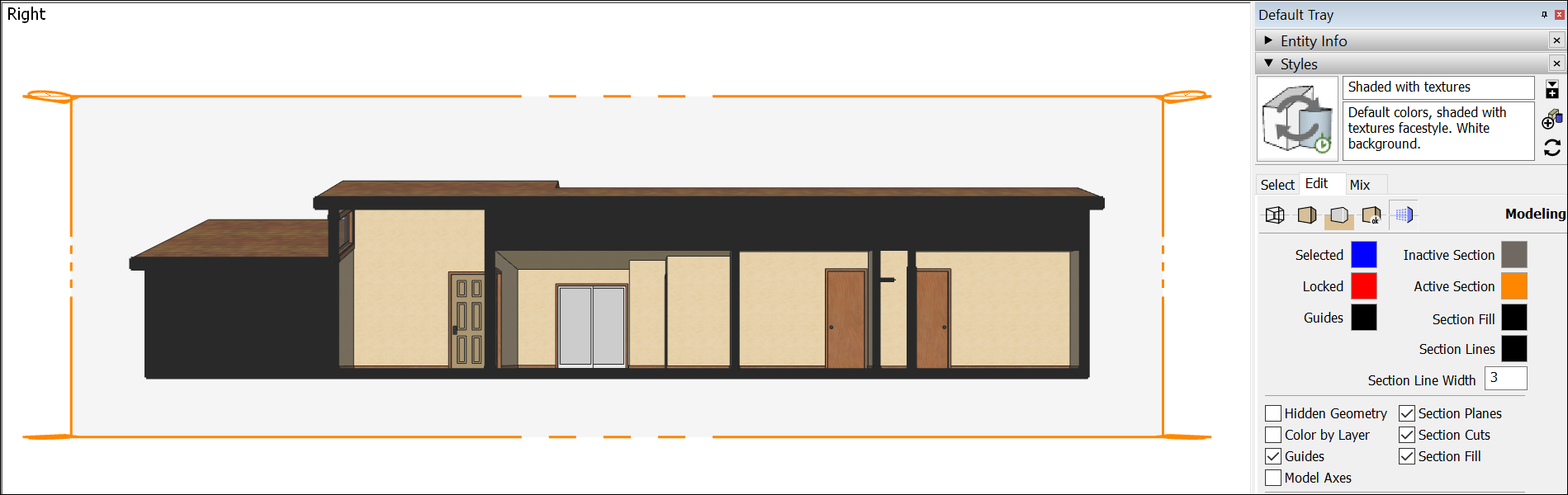
Yous tin can apply section planes for all types of applications:
- Cut a building horizontally to meet the flooring plan. In architectural drawing, this two-dimensional peak-down cutting is chosen a planimetric view.
- Cut a building vertically to run into inside the rooms of several floors at once. This type of cut is called a sectional view (non to be dislocated with SketchUp'south department planes).
Tip: To create a planimetric view similar an builder, place the section plane 48 inches in a higher place the flooring's surface. This placement usually enables y'all to see windows and doors in the piece without cut through countertops or piece of furniture. To create a exclusive view, don't cut through columns, because they'll look like walls instead of objects that people can walk around; do cut through stairs or elevators, because this shows how people move through the building.
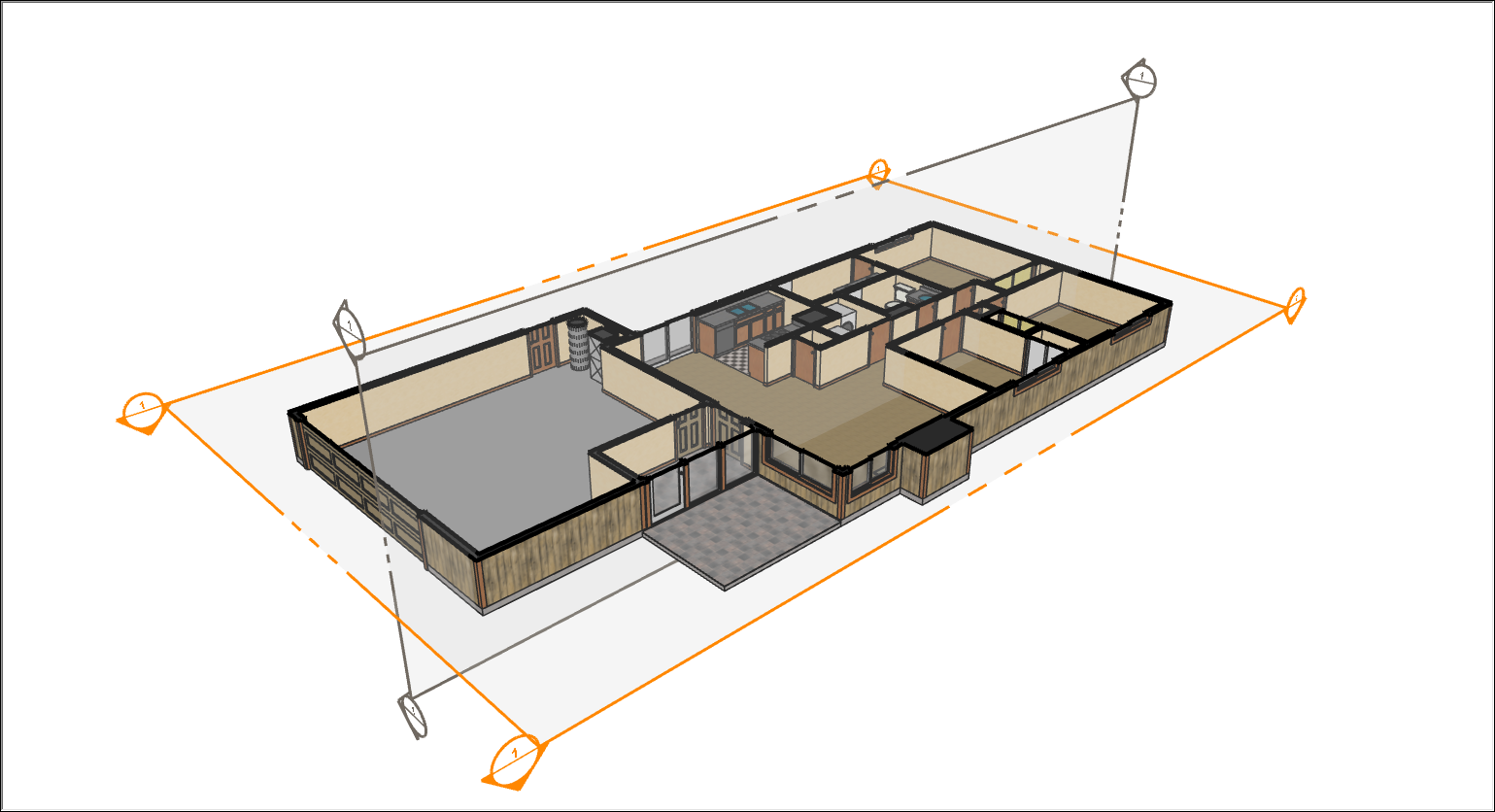
In SketchUp, you lot can insert multiple section planes, merely merely i section plane can be the active cutting in each context. Y'all create more than 1 context in a model by creating groups or components, each of which has a dissever context. For instance, the following model is a component and has 2 department planes; the department airplane that shows the plan is agile.
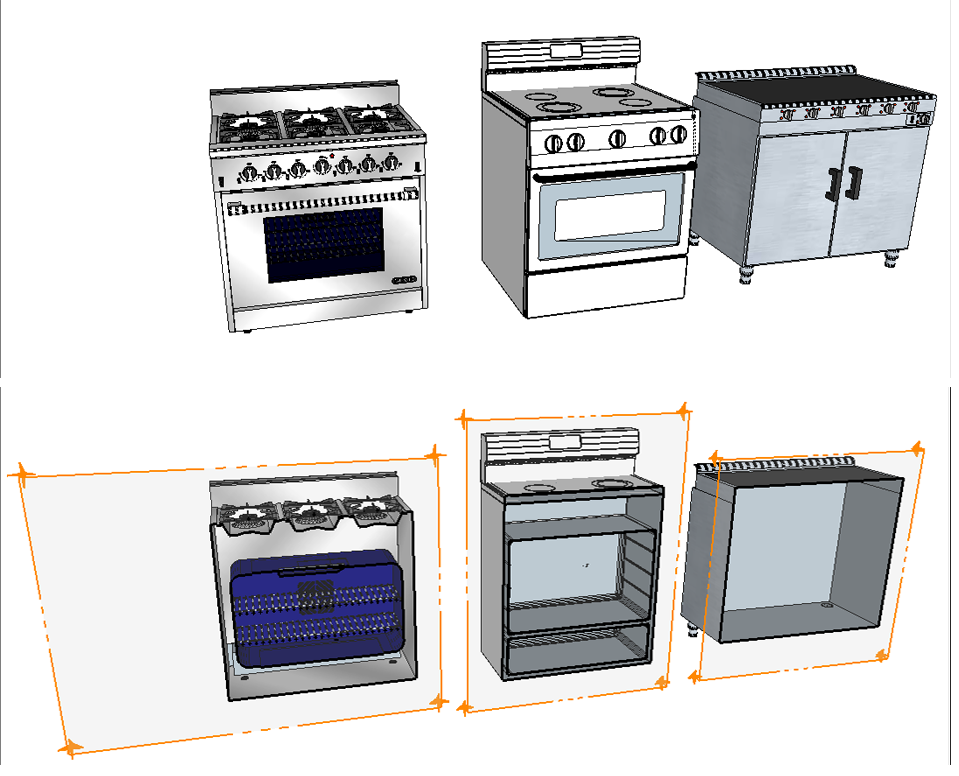
Another case is this model that contains several ovens. Each oven is a separate group, every bit shown in the post-obit figure. Y'all can display an active section aeroplane in each group to see that none of the ovens contains a warm apple tree pie or chocolate chip cookies. (Darn it!) See Grouping Geometry and Creating a Bones Component for details about creating groups or components and how to open or close a grouping or component context.
Tip: Want to testify off multiple interior views of a model? SketchUp enables you to evidence section cuts in scene animations. To animate scenes that bear witness different section cuts, you need to save the section settings in a fashion and then save each view in a scene. Animative Scenes explains how to create animations of your model.
The post-obit video introduces y'all to section planes and gives you a sneak peek at section aeroplane animation. In the upcoming sections, you find detailed steps that walk yous through the many things section planes can practise.
Tabular array of Contents
- Adding a section plane
- Filling voids in section cuts
- Creating new geometry from a section aeroplane
- Showing or hiding section planes, cuts, and fills
- Exporting section cut furnishings
Adding a section airplane
Inserting a department airplane is like shooting fish in a barrel as pie. Make sure nothing in your model is selected, and open up the group or component context where y'all want to add the section airplane. Also, if y'all desire to identify the section aeroplane at a specific height, such as 48 inches to a higher place the floor surface, use the Tape Measure tool to set a guide line that volition help you identify the department plane precisely where you want it.
When you lot're ready to add a section aeroplane, follow these steps:
- Select the Section Airplane tool (
 ) or select Tools > Section Plane. Microsoft Windows users find the Section Plane tool on the Sections toolbar. On both Microsoft Windows and Mac Bone X, the Section Plane tool is on the Big Tool Ready palette.
 - With the section aeroplane cursor, shown in the following effigy, click a face up to place your section aeroplane.
Tip: If you lot take trouble keeping the section plane in your desired orientation, hover over a face that matches the orientation yous want and concord down the Shift key to lock the section plane cursor'southward direction. Y'all tin can also tap the arrow keys to orient the normal of the department airplane to the default axes directions: Upward for Blue axes, Right for Red axes, Left for Green Axes, and Downwards for parallel to face.
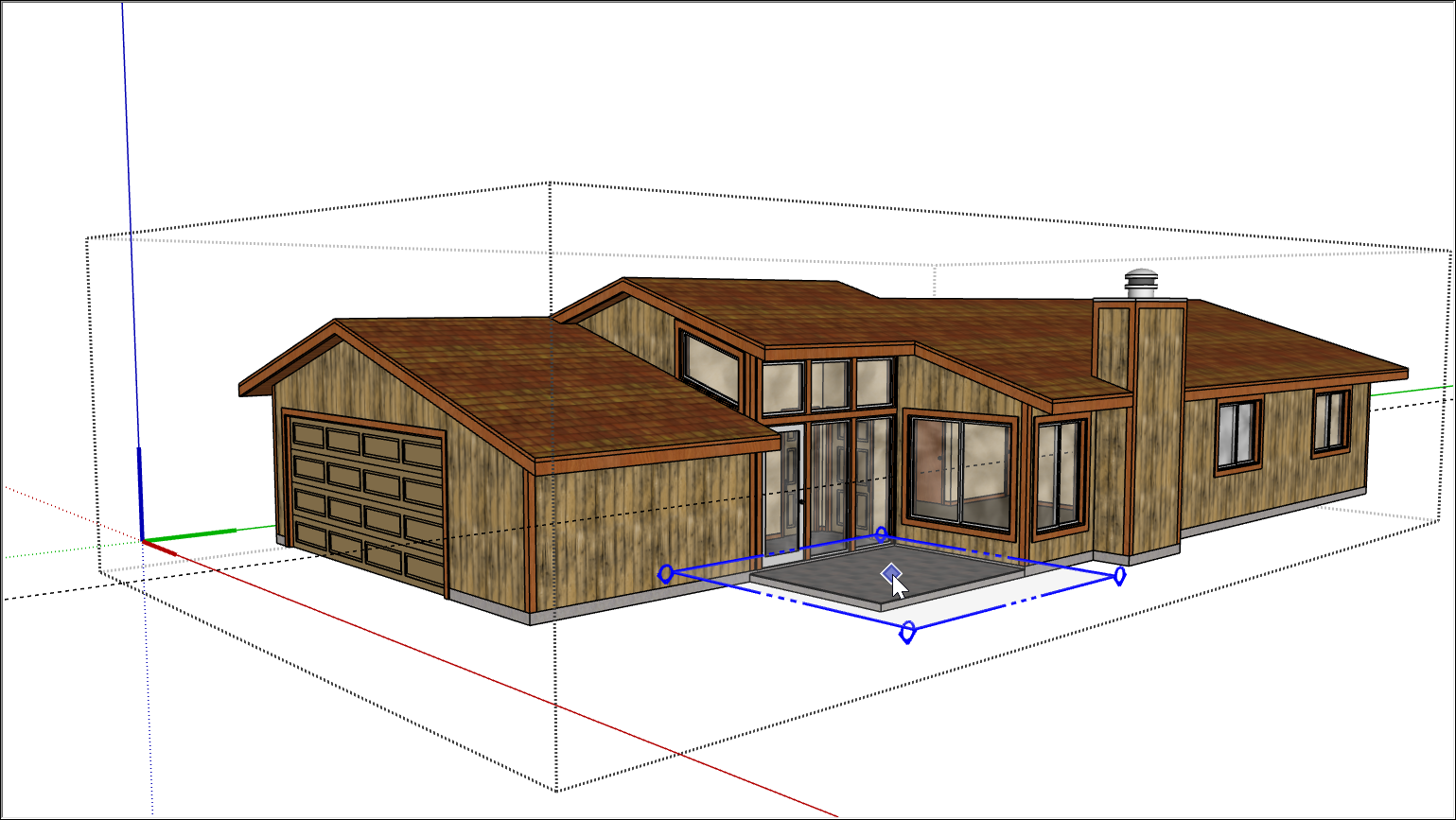
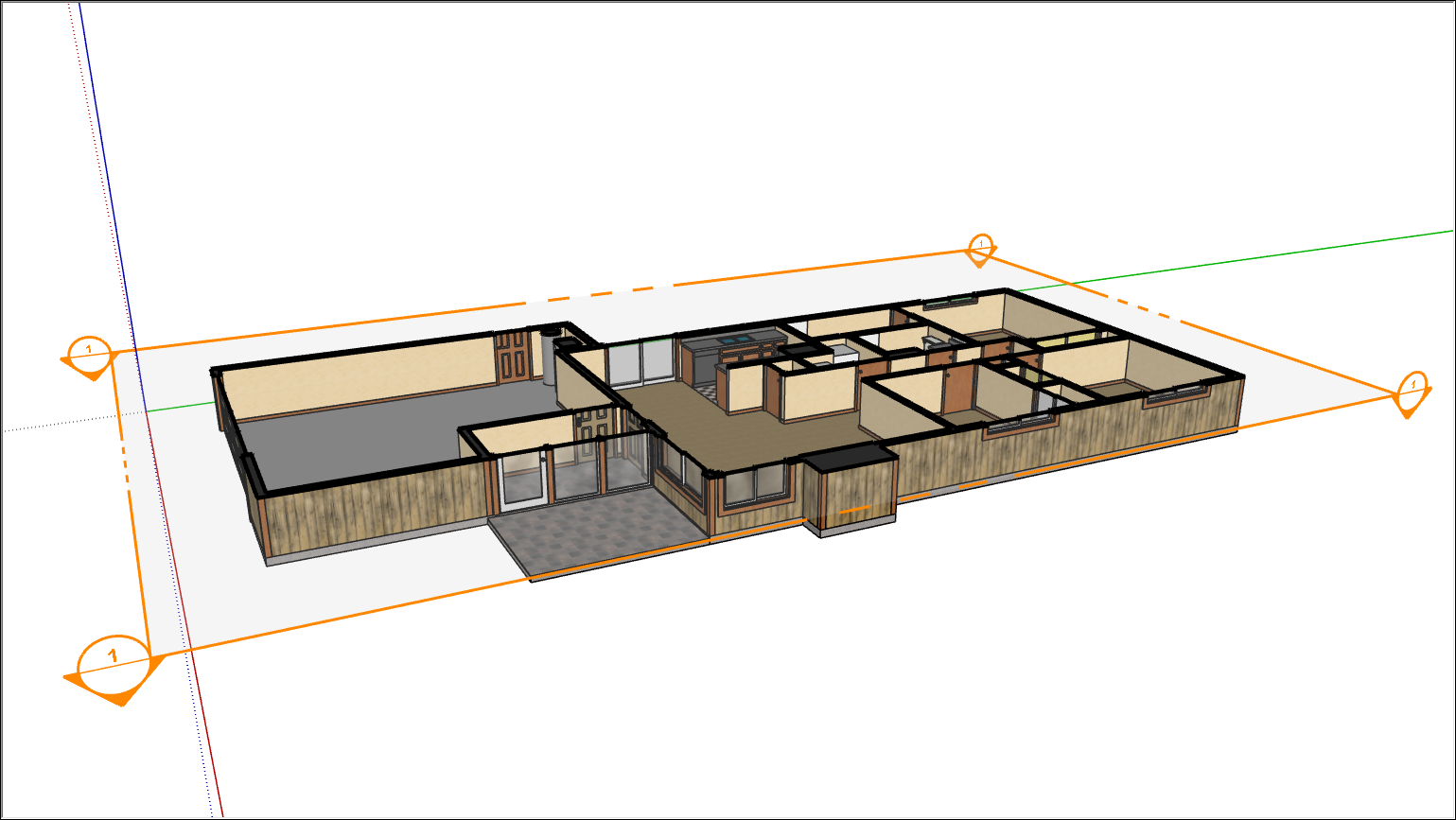
- Adjust the placement with the Move tool or the Rotate tool.
- Reverse the cutting direction by context-clicking the section plane and selecting Opposite from the card that appears. For example, if you make a vertical cut, yous can opposite the cut to brandish the inside of the other half of your building.
- Align SketchUp's camera with the department plane by context-clicking the section plane and selecting Marshal View. In the preceding figure, adjustment the view to your section plane takes yous to a top view of the model.
- Select which section plane is the agile cutting, if y'all take more than one, by context-clicking the section plane yous want to brand active and selecting Agile Cut from the menu. Or, double-click the department aeroplane you'd like to activate or deactivate.
- Control section plane visibility. See details virtually hiding or showing section planes later in this article.
Tip: Desire a quick way to manage your department planes? Each section plane appears in the Outliner console with the name you entered when you lot created the section plane. You can edit the department plane's name and symbol in the Outliner or the Entity Info panel.
In the Outliner, yous tin likewise context-click a section plane and use the menu that appears to hide, activate, reverse, and take other actions to manage that section plane. Double-clicking the proper noun in the Outliner activates or deactivates the section plane.
Annotation: When you utilize the Align View command in Parallel Projection perspective, you can quickly generate exclusive elevation or 1-point perspective views of your model.
Filling voids in department cuts
When you slice a solid with a department plane, you may not desire to see voids where solid material should exist. For instance, say a section plane is showing a sliced concrete block. Depending on your section fill settings, the model might bear witness empty infinite where the concrete cake would be filled.
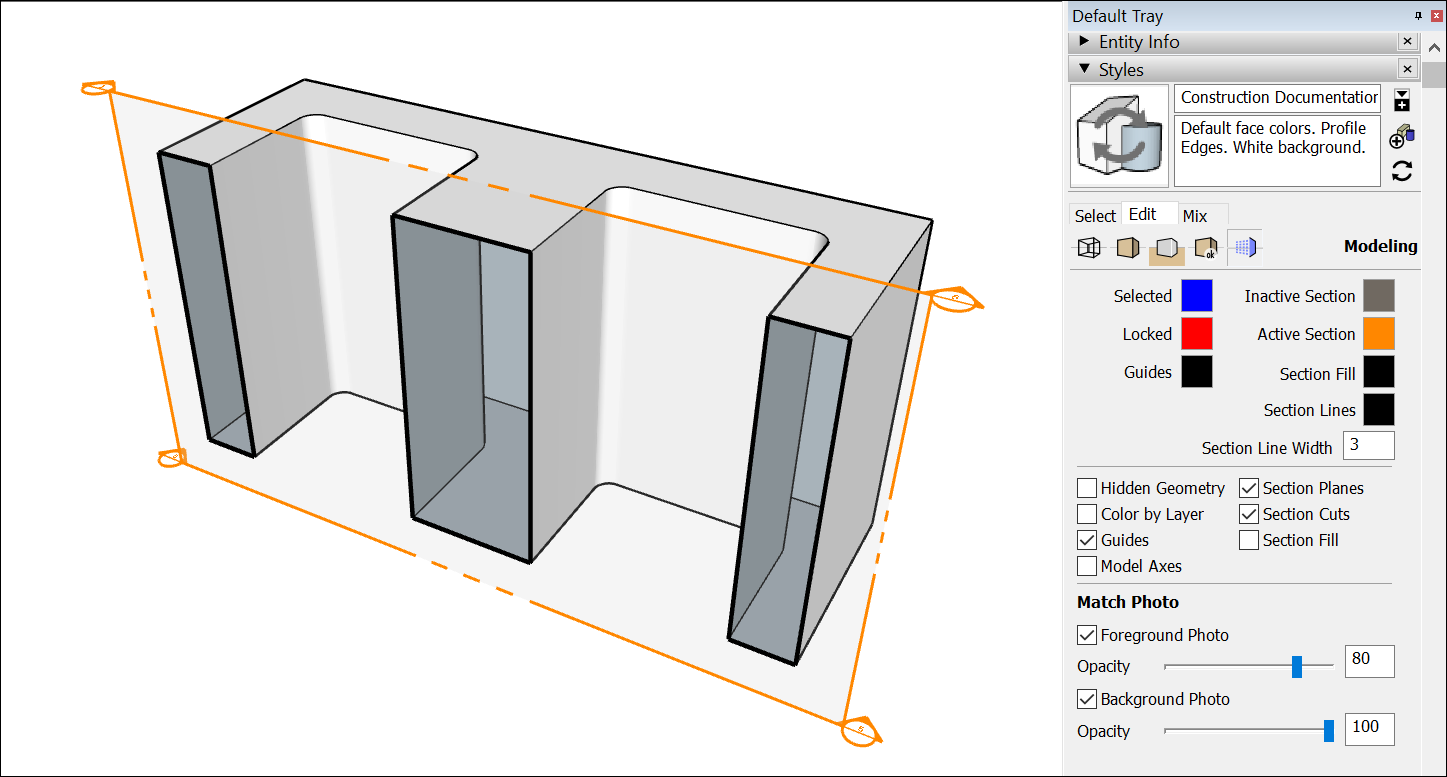
To fill up closed loops in the slice, you can only select the Department Fill check box in the Styles panel. For example, the following figure shows how the physical cake changes when the Section Fill check box is selected. Alternately, yous can toggle section fill up visibility with the View > Department Fill command or the Display Section Fill button ( ) on the toolbar. (Recall that whether you utilise the Styles panel, View bill of fare, or toolbar buttons, you change the style and need to save the mode if yous don't want to lose the visibility settings yous've practical.)
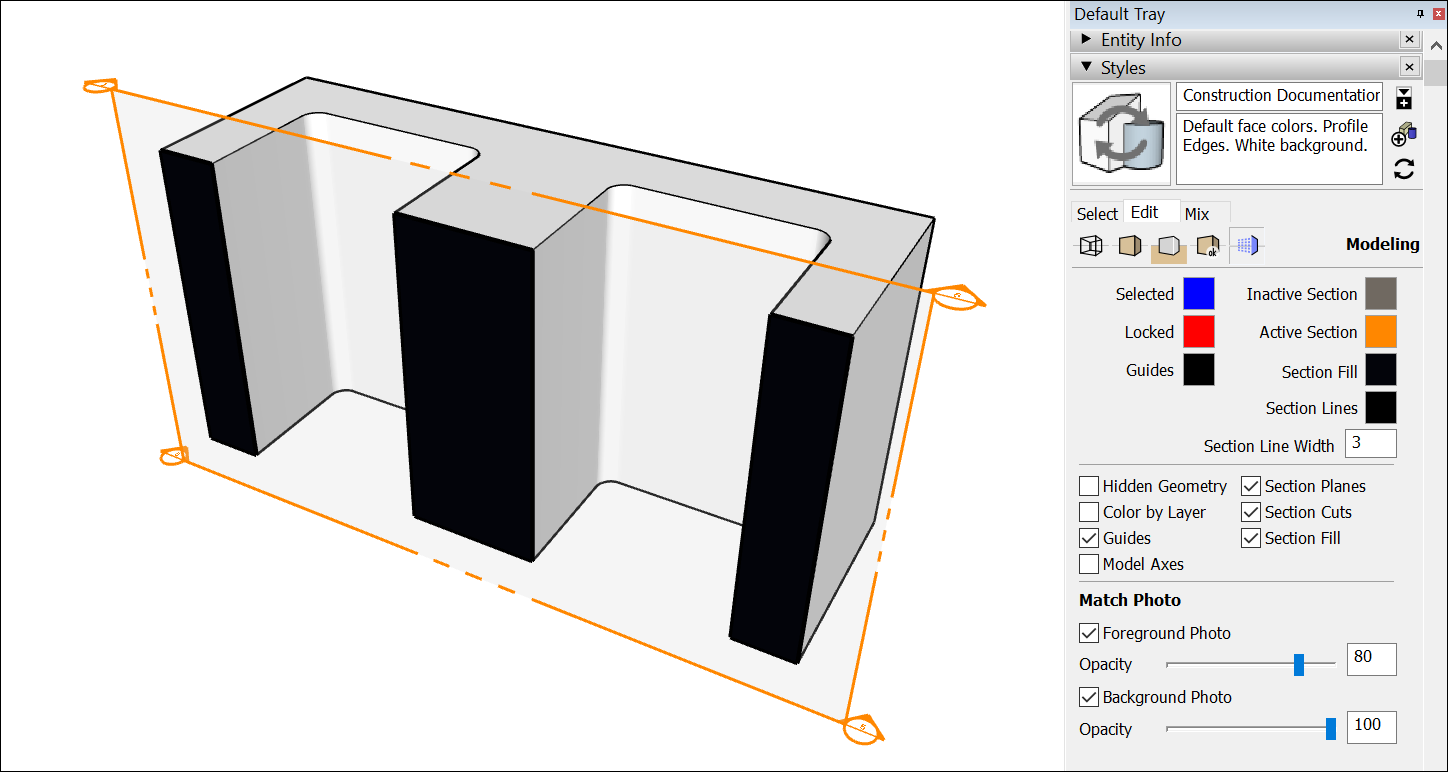
To control the Department Make full settings in the Styles panel, follow these steps:
- Open the Styles panel.
- Click the Edit tab.
- On the Edit tab, click the Modeling Settings icon (
 ).
). - To fill areas that are closed loops, select the Section Fill bank check box. Remember that, to create a filled section cut, the geometry in the section slice must form a airtight loop inside its group or component hierarchy. You lot can encounter that hierarchy in the Outliner.
- (Optional) To adjust the colour, click the Section Fill color swatch and use the color picker to cull your desired color.
Tip: Need some help troubleshooting a fill? Context-click the section airplane and choose Troubleshoot Section Fill. You then come across red circles around the vertices that border the opening in the loop.
Come across Customizing Modeling Settings to Complement a Fashion for more details about your Modeling Settings options.
Creating new geometry from a department plane
Where a department plane intersects with a model, SketchUp enables you to create geometry, which is automatically organized into a group. You can then move that group to a new location in your model, so you have a copy to work with, as shown in the post-obit figure. Or explode the group so you tin can utilize the geometry to divide your model.
To create geometry in this mode, context-click a section plane and select Create Group from Piece from the menu that appears.
Tip: If you have trouble seeing or selecting the group, select the group in the Outliner.
When a section aeroplane cuts your model, the cutting isn't permanent, and you can control the visibility of the plane and the cut independently of each other. Hiding the section plane makes the transparent plane with its color handles disappear. Hiding the section cut makes your model look whole again.
Here'due south how to control the visibility of your section planes and cuts:
Tip: Microsoft Windows users can detect all the department tools on the Section toolbar. Mac OS Ten users tin can add section tools to the principal toolbar. See Customizing Your Workspace for details.
Exporting section cut furnishings
No affair what version of SketchUp you lot take (Make or Pro), you tin can consign an epitome of your model displaying department cut effects. You can use these images in portfolios, presentations, websites, or basically anywhere you might desire to evidence off an image of your work. Just make sure your model shows the section cut as you desire information technology to appear in your image. Run into Using SketchUp Data with Other Modeling Programs or Tools for details about exporting a model as an image or other file type.
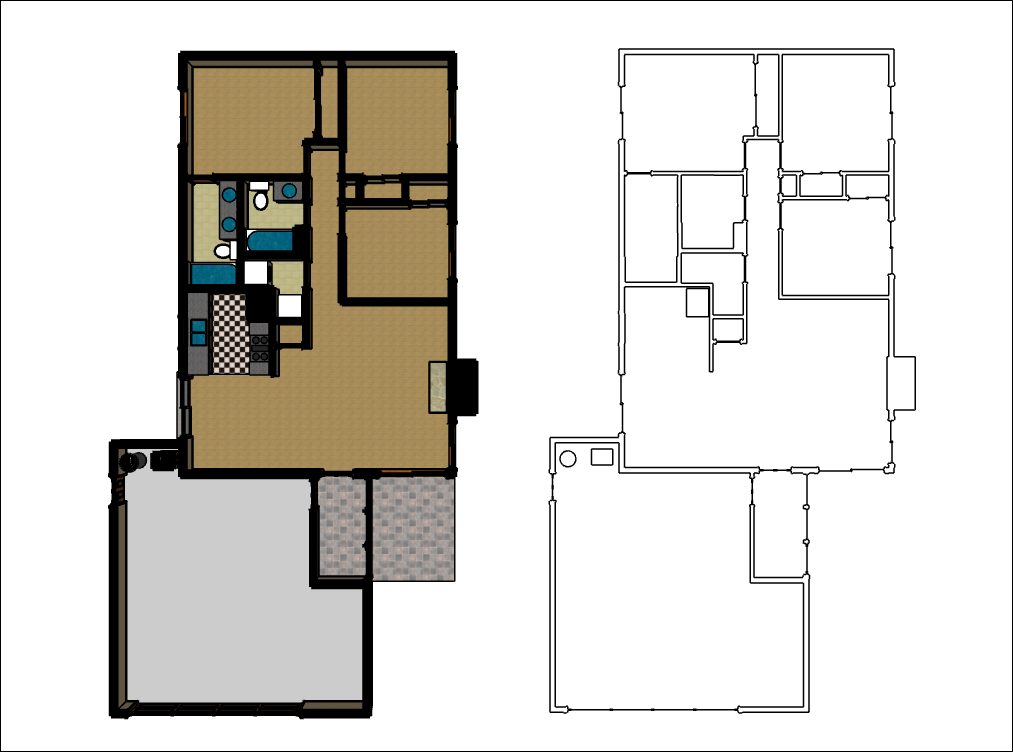
PROWith SketchUp Pro, y'all can also export a department slice, which is a 2d vector image of geometry along a department aeroplane. Here are a simply a few ways you might employ a section slice:
- Create scaled drawings in a CAD program. If yous created a 3D model with precise measurements and angles, the section slice characteristic enables yous to scale the slice. (Technically, yous tin can scale imprecise models, also; the scale just doesn't mean annihilation.)
- Edit the piece every bit a vector image. Because the 2nd slice is exported every bit a vector graphic, you may be able to open the exported file in programs like Adobe Illustrator.
Tip: When the scale of your 2nd piece is important, pay close attention to your view in SketchUp. If your view is set to Perspective, you can't export to scale. If yous're viewing your model in Parallel Project view, only faces whose normals are perpendicular to the view bending are measurable. Viewing a Model explains what the different views show and how to change your view.
PRO To export a department slice from SketchUp Pro, follow these steps:
- If your section airplane is within a group or component context, double-click the group or component to open up its context.
- Select the department airplane with the section cut that you want to export.
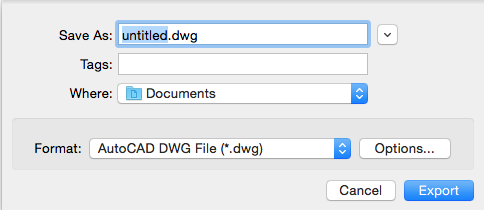
- Select File > Export > Section Piece. The Consign second Section Piece dialog box appears, every bit shown in the following effigy.
- Choose where you want to save the file. By default, the file is saved in your Documents binder.
- Blazon a proper name for the exported file in the File Proper noun box (Microsoft Windows) or Save Every bit box (macOS).
- Select what blazon of file y'all want to export from the Save Equally Type box (Microsoft Windows) or Format box (macOS). The default option is
.dwgor you can select.dxf. Both of these are AutoCAD file types. - (Optional) Click the Options button to open a dialog box where you can select your options. The following list outlines what your options hateful. After you lot're washed selecting options, click OK to render to the Export 2D Section Piece dialog box.
- Click the Export push. Your file is saved in the location you selected in Step four.

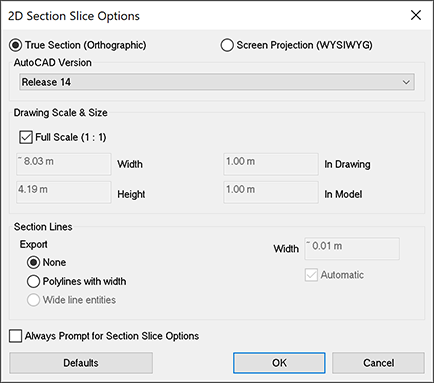
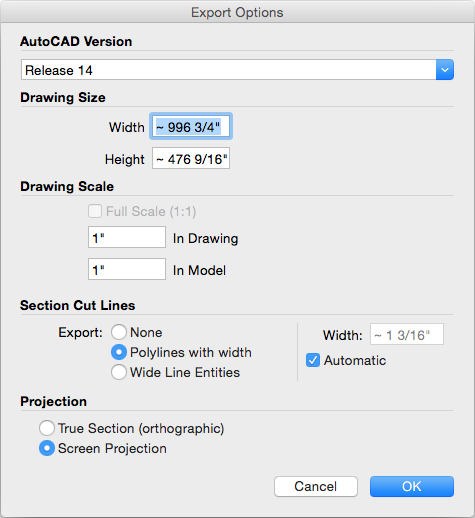
When you consign a second piece, you can cull from the following options:
- True Section (Orthographic) exports the section slice as a true orthographic drawing. This is useful for creating templates for CAD drawings or any other fourth dimension you want to generate authentic, measurable slices.
- Screen Projection projects the department cut as you come across information technology on your SketchUp screen, including whatever perspective distortion. This is most useful for diagrams that you don't need to measure.
- AutoCAD Version enables you to select the version of AutoCAD you lot programme to employ from the drop-down list.
- Drawing Scale and Size options enable you to configure the scale of the exported section slice. If Total Scale is selected, SketchUp exports the file at a ane:one scale. The In Drawing and In Model options enable y'all to specify a drawing scale, where In Drawing is the measurement of the exported geometry and In Model is the object's actual measurement. For example, for a scale of 1:iv, enter i" in the In Drawing box and 4" in the In Model box.
- Department Lines options enable you to cull how the section cut lines in your exported slice appear. None exports the lines at normal width. Polylines with Width turns the lines into polylines. Wide Line Entities (only available when exporting
.dwgfiles to AutoCAD 2000 or later on) makes the lines in the exported file wider than normal. If yous desire to set up the line width automatically, leave the Automatic checkbox selected. Or clear Automatic and enter a value in the Width box to set an exact line width.
On Microsoft Windows, you also see Section Line options for separating profile edges on a layer and e'er being prompted for section piece options.
- The Separate on a Layer choice creates a single boosted layer for profile edges. This layer is useful if you would like to plot profile lines using a different pen weight or quickly change the line width of all contour lines in a dissever CAD or illustration program.
Tip: The Separate on a Layer option is different from layer assignments in SketchUp. SketchUp Layer assignments exercise not translate directly when exporting 2D hidden line vectors.
- Select the Always Prompt for Section Slice Options checkbox, and SketchUp displays the 2nd Department Piece Options dialog box every time you export a department piece. When this checkbox is cleared, past default, SketchUp uses whatever options were selected last time.
Source: https://help.sketchup.com/en/sketchup/slicing-model-peer-inside

Post a Comment for "autocad 3d drawing line perpendicular to plane"