Give Us Hawaii Back We Will Return It to Paradise Again


Queen Liliʻuokalani, 1908
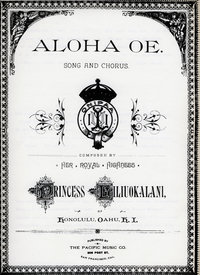
"Aloha ʻOe" (Good day to Thee) is a Hawaiian folk song written circa 1878 by Liliʻuokalani, who was and so Princess of the Hawaiian Kingdom. It is her well-nigh famous vocal and is a common cultural symbol for Hawaii.
Background [edit]
The story of the origin of the vocal has several variations.[one] They all have in mutual that the song was inspired past a notable farewell embrace given by Colonel James Harbottle Boyd during a horseback trip taken by Princess Liliʻuokalani in 1877 or 1878 to the Boyd ranch in Maunawili on the windward side of Oʻahu, and that the members of the party hummed the tune on the mode back to Honolulu. Unlike versions tell of alternate recipients of the comprehend—either Liliʻuokalani's sister Princess Likelike Cleghorn or a young lady at the ranch.[2] According to the nearly familiar version of the story:
This tender farewell set up Liliʻuokalani to thinking, and she began humming to herself on the homeward trip. Overhearing, Charles Wilson observed, "That sounds similar The Lone Rock by the Bounding main," a comment with which Liliʻuokalani is said to accept agreed. When the party paused to balance in an orangish grove on the Honolulu side of the Pali, the others joined in the hummings, and the vocal was completed afterwards at Washington Place.[3]
The Hawaiʻi Country Athenaeum preserves a mitt-written manuscript[4] past Liliʻuokalani, dated 1878, with the score of the song, the lyrics, Liliʻuokalani'south English language translation, and her note evidently added later: "Composed at Maunawili 1878. Played past the Royal Hawaiian Band in San Francisco Baronial 1883 and became very popular."
The first known recording of the song was released past Berliner Gramophone in 1898.[5] A catalogue issued by Columbia Records in 1901 mentioned ii wax cylinders labeled "Vocal Solos in Hawaiian", containing some of the before recordings of "Aloha ʻOe" and "Kuʻu Pua I Paoakalani". However, it is uncertain if this was recorded in Hawaii or if the performer was Hawaiian and the cylinders are at present lost.[6] Columbia Records later recorded a duet of the vocal by Nani Alapai and Henry Northward. Clark in 1911.[vii] A 1913 score tin can be seen at the Levy Sheet Music Drove.[8]
Lyrics [edit]
| Haʻaheo e ka ua i nā pali | Proudly swept the rain by the cliffs |
| Ke nihi aʻela i ka nahele | As it glided through the copse |
| E hahai (uhai) ana paha i ka liko | Nonetheless post-obit always the bud |
| Pua ʻāhihi lehua o uka | The ʻāhihi lehua[a] of the vale |
| Hui: | Chorus: |
| Aloha ʻoe, aloha ʻoe | Bye to thee, farewell to thee |
| E ke onaona noho i ka lipo | The mannerly one who dwells in the shaded bowers |
| Ane fond cover, | One fond encompass, |
| A hoʻi aʻe au | Ere I depart |
| Until nosotros meet again | Until we meet once again |
| ʻO ka haliʻa aloha i hiki mai | Sweet memories come back to me |
| Ke hone aʻe nei i | Bringing fresh remembrances |
| Kuʻu manawa | Of the past |
| ʻO ʻoe nō kuʻu ipo aloha | Dearest ane, aye, yous are mine ain |
| A loko east hana nei | From you, true beloved shall never depart |
| Tomago: | Refrain: |
| Maopopo kuʻu ʻike i ka nani | I accept seen and watched your loveliness |
| Nā pua rose o Maunawili | The sugariness rose of Maunawili |
| I laila hiaʻai nā manu | And 'tis in that location the birds of love dwell |
| Mikiʻala i ka nani o ka liko | And sip the love from your lips |
| Hui | Chorus |
Musicology [edit]
Parts of "Aloha 'Oe" resemble the song "The Lone Rock by the Sea" and the chorus of George Frederick Root'southward 1854 song "There's Music in the Air".[9] "The Solitary Rock by the Body of water" mentioned by Charles Wilson, was "The Stone Beside the Sea" published past Charles Crozat Converse in 1857,[10] and itself derives from a Croation/Serbian folk song, "Sedi Mara na kamen studencu" (Mary is Sitting on a Stone Well).[11] [12] The "Aloha Oe" Chorus melody was likewise used every bit the counterpoint to the chorus of the jazz song, Hula Lou and too could be a counterpoint to Woody Guthrie'southward folk vocal, This Land is Your Land.
Notable recordings [edit]
- 1911 Nani Alapai and Henry N. Clark – recording for Columbia Records[7]
- 1924 Frank Ferera – this reached the charts of the 24-hour interval.[thirteen]
- 1936 Bing Crosby – recorded July 23, 1936 with Dick Mcintyre and His Harmony Hawaiians.[14]
- 1946 Les Paul and His Trio – recorded March 29, 1946 for Decca Records (itemize No.23685).[fifteen]
- 1961 Elvis Presley - recorded March 21–23, 1961 for RCA Records as the soundtrack for the movie Blue Hawaii
Movie appearances [edit]
- 1936 Waikiki Hymeneals – sung by chorus
- 1938 Hawaii Calls
- 1953 From Hither to Eternity
- 1961 Blue Hawaii – sung past Elvis Presley
- 1989 The Karate Child Office III — hummed by Daniel while irresolute
- 2002 Lilo & Stitch – the song is sung briefly by the grapheme Nani Pelekai (voiced by Tia Carrere) as a ways to say goodbye to her sister Lilo, from whom she was preparing to be separated the following day. It is sung once more in its franchise's 4th flick Leroy & Sew together (2006) by Lilo (Daveigh Chase), Sew (Chris Sanders), and Reuben (Rob Paulsen) to shut downwards the Leroy clones.[16] [17] The song also appears on the soundtrack of Lilo & Sew together 2: Sew Has a Glitch (2005).[18]
- 2005 Aloha, Scooby-Doo! – Sung by the Wikki Tikki in the motion picture'south climax.
- 2016 Train to Busan – partially sung by one of the primary characters, and is also instrumental in the film'due south conclusion.
In popular civilization [edit]
The vocal besides plays in many episodes of SpongeBob SquarePants, albeit in instrumental grade.
The song also plays in Disney's Lilo and Stitch where Nani sings to Lilo, in beautiful soft tones.
In the episode "Cruise Cat" of the Tom and Jerry in 1952, a guitar version of this song became i of the animation's Background music,[19] and the destination of the liner in the episode was Hawaii.[20]
In the offset episode of the 1963 Hanna-Barbera drawing; Elevation Cat entitled "Hawaii, Here We Come", at the first of the episode, Benny the Ball sings the song, after winning a gratuitous trip to Hawaii, old later Officeholder Dibble also sings the song. They both still replace some of the lyrics with English language ones.
"Aloha 'Oe" appeared in the scores of many of Warner Bros.' classic Looney Tunes and Merrie Melodies cartoons, as composer Carl Stalling'southward stock musical cue for Hawaii-themed gags. Usually instrumental, merely Bugs Bunny really sings one line of the refrain at the very stop of Case of the Missing Hare. In the 1953 cartoon short, Duck Amuck part of it is briefly sung by Daffy Duck when the scenery is inverse to a Hawaiian setting, courtesy of a sadistic mystery animator and again in A Squeak in the Deep. In the 1958 Oscar-winning curt Knighty Knight Bugs, the cartoon ends with an enchanted sword performing an instrumental version of the song (played by a musical saw).
The chorus of the song serves as the intro for Fasten Jones' interpretation of "Hawaiian War Dirge". ("As the sun pulls away from the shore, and our boat sinks slowly in the westward...")
The vocal also appeared in the Popeye the Sailor brusk, Alona on the Sarong Seas, where information technology was played in the beginning of the short, and afterward Popeye eats his spinach.
In the Japanese anime Space Smashing (created in 2014), the eponymous main graphic symbol is captain of a spaceship called the Aloha Oe.[21] [22]
The Jack London short story Aloha Oe features the chorus of the song.[23]
When Jiang Zemin, then-Chinese President and the General Secretary of the Communist Political party of China, arrived at Hawaii at the beginning of his state visit to U.Due south. in Oct 1997, he played "Aloha 'Oe" with a Hawaiian lap steel guitar and invited then Hawaiian Kickoff Lady Vicky Cayetano to sing the song at a dinner with the presence of Governor Ben Cayetano. Jiang recounted that he used to ofttimes play this song when he was in college in 1940s.[24] [25]
It also used in the final scene of Train to Busan when Soo-an sings in the tunnel as tribute to her male parent's sacrifice.
The castaways sing the song as a practiced luck charm to a robot toward the cease of the Gilligan's Isle episode "Gilligan's Living Doll," as it is about to walk from the isle underwater all the way to Hawaii.
The vocal is played in the eighth episode of the eighth season of The Simpsons, "Hurricane Neddy", when Ned Flanders drives away to the psychiatric hospital.
The vocal appeared in episode iv of the HBO miniseries The White Lotus.
Run across also [edit]
- Music of Hawaii
- List of compositions and works by Liliʻuokalani
Notes [edit]
- ^ A Hawaiian blossom (Metrosideros tremuloides)
References [edit]
- ^ The Queen's Songbook, by Her Majesty Queen Liliʻuokalani, Hui Hanai, Honolulu, 1999, pp. 38–39. ISBN 0961673877.
- ^ Wong, Jonathan. "Aloha Oe". Retrieved May 28, 2018 – via Huapala.org.
- ^ Kelsey, Theodore. 1927. "The Queen's Poem — 'Aloha ʻOe,' by Liliuokalani," Paradise of the Pacific 40: 4. Cited in The Queen's Songbook past Her Majesty Queen Liliʻuokalani. Hui Hanai, Honolulu, 1999. Dorothy Kahananui Gillett, text and music notation; Barbara Barnard Smith, Editor. Also, run into Aloha Oe Archived 2011-09-28 at the Wayback Machine
- ^ "Translation of "Aloha Oe" handwritten past Liliuokalani, Queen of Hawaii, 1838–1917". gallery.hawaii.gov.
- ^ Steffen, David J. (2005). From Edison To Marconi: The First Thirty Years Of Recorded Music. McFarland & Company. p. 199. ISBN978-0-7864-2061-2.
- ^ Schmitt, Robert C. (1978). "Some Firsts in Island Leisure". The Hawaiian Journal of History. Honolulu: Hawaiian Historical Order. 12: 99–119. hdl:10524/376. OCLC 60626541. ; Schmitt, Robert C. (1995). "Notes & Queries – TIn Foil and Wax: Hawaiʻi's First Phonograph and Records". The Hawaiian Periodical of History. Honolulu: Hawaiian Historical Society. 29: 183–186. hdl:10524/509. OCLC 60626541.
- ^ a b Bryan, Martin F.; Bryant, William R.; Sears, Roebuck and Visitor (1975). Oxford and Silvertone records, 1911–1918. St. Johnsbury, VT: New Amberola Phonograph Co. p. 30. OCLC 2593220.
- ^ "151.019 – Aloha Oe. (Good day To Thee). [English and Hawaiian] – Levy Music Collection". levysheetmusic.mse.jhu.edu.
- ^ "Nalu Music » Aloha 'Oe". world wide web.nalu-music.com . Retrieved May 28, 2018.
- ^ "126.093 – The Rock Abreast the Ocean. A Romanza. – Levy Music Collection". levysheetmusic.mse.jhu.edu.
- ^ "The Originals: Aloha Oe". Archived from the original on 2011-09-28. Retrieved 2011-05-xvi .
- ^ "YouTube". world wide web.youtube.com. [ dead YouTube link ]
- ^ Whitburn, Joel (1986). Joel Whitburn's Pop Memories 1890–1954 . Wisconsin, USA: Tape Research Inc. p. 155. ISBN0-89820-083-0.
- ^ "A Bing Crosby Discography". BING magazine. International Social club Crosby. Retrieved Baronial 12, 2017.
- ^ "The Online Discographical Project". 78discography.com . Retrieved August 12, 2017.
- ^ "Lilo and Sew together Aloha 'Oe". wn.com. Retrieved April 4, 2014.
- ^ "Lilo and Stitch Versions of Aloha Oe". History of Hawaii. Retrieved April 4, 2014.
- ^ Phares, Heather. "Lilo & Sew together ii: Island Favorites". All Music. Retrieved April 4, 2014.
- ^ "Cruise Cat Soundtracks". IMDB. 1952. Retrieved September 27, 2018.
- ^ Tom and Jerry Cartoon – Prowl Cat 2015, YouTube, Uploaded on December 1, 2015
- ^ Dark-green, Scott. "Effigy Sculptor Makes "Space Nifty" Aloha Oe and QT". Crunchy Roll. Retrieved April iv, 2014.
- ^ Green, Victoria. "'Infinite Dandy' Recap: A Merry Companion Is a Wagon in Space, Baby". The Glory Cafe. Archived from the original on April seven, 2014. Retrieved April 4, 2014.
- ^ London, Jack (1993). The Complete Short Stories of Jack London, Volume 1. ISBN9780804720588 . Retrieved April 28, 2014.
- ^ "President Jiang Zemin of China". partners.nytimes.com . Retrieved March 29, 2016.
- ^ StevenChangHZ (April 19, 2012), 江澤民演奏夏威夷吉他 [Jiang Zemin Playing Hawaiian Guitar], archived from the original on 2021-12-21, retrieved March 29, 2016
External links [edit]
 Media related to Aloha ʻOe at Wikimedia Eatables
Source: https://en.wikipedia.org/wiki/Aloha_%CA%BBOe

Post a Comment for "Give Us Hawaii Back We Will Return It to Paradise Again"